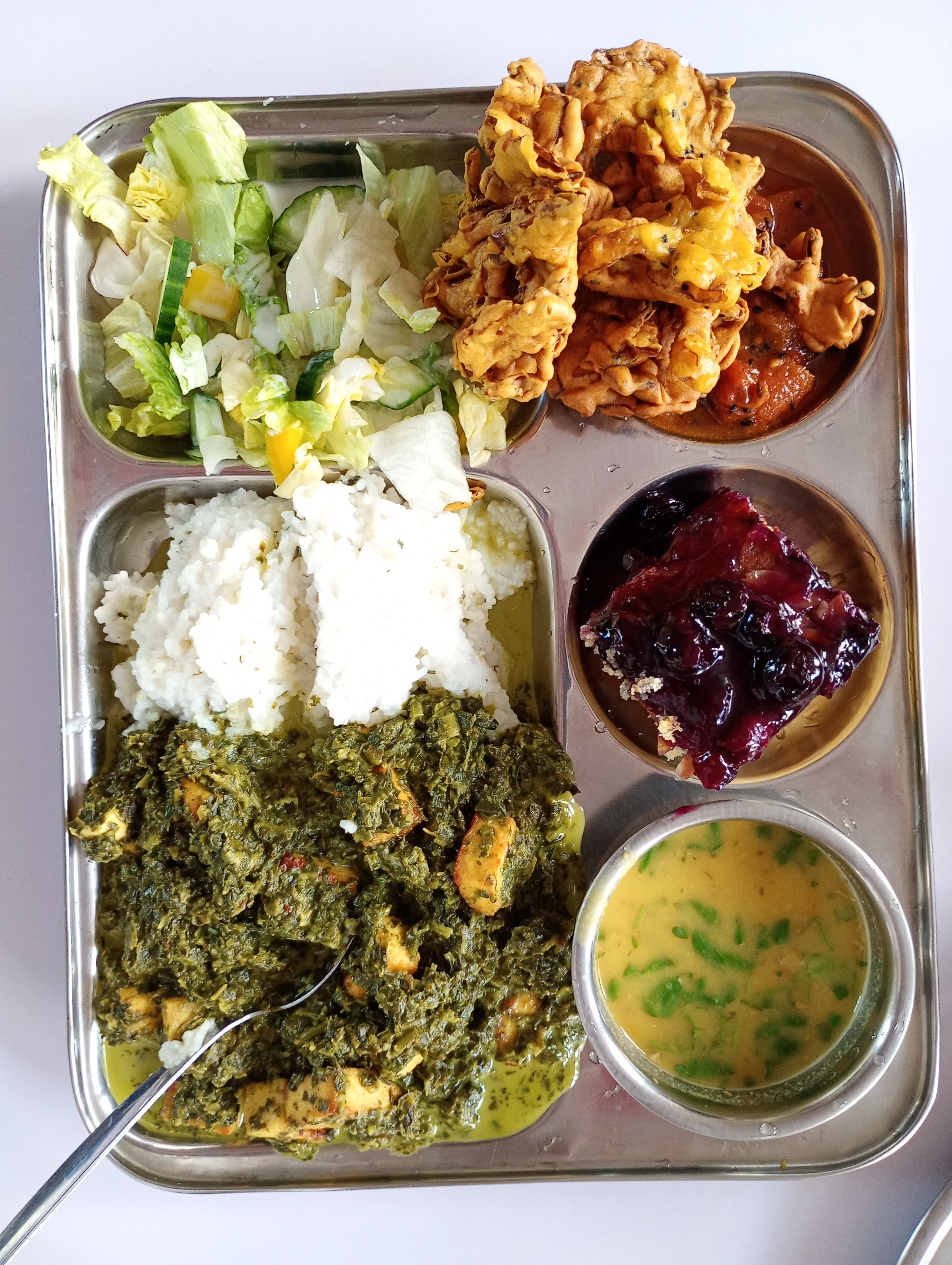
About food and vegetarianism

Hare Krishna devotees do not eat meat, fish, or eggs. We do this because we strive to live as nonviolently as possible and to cultivate the quality of compassion. Nowadays, vegetarianism is quite common, and many people are vegetarian, flexitarian, or vegan. Nevertheless, we are still often asked why we do not eat eggs but do drink milk, about milk from industrial dairy farming, and about the killing of plants.

Why don’t you eat eggs?

Eggs are a product of the reproductive cycle of hens. Whether they are fertilized or unfertilized, we do not eat them because they are considered impure. Furthermore, they are laid by hens that often have little freedom of movement and lack access to freedom, space, and natural light.
You still kill plants, even if you are vegetarian, don’t you?

Yes, taking life is sometimes necessary when it comes to vegetables, though not in the case of fruit. Since one form of life serves as the basis for another—and because we must eat something in order to survive—we sometimes have to take life in order to sustain life. However, we should always try to choose foods that cause the least possible suffering. Plants experience much less sensation than vertebrate animals. Moreover, plants can be offered to Krishna.

Why do you drink milk from cows if you do not eat their meat?

By drinking milk, we receive all the necessary nutrients without harming the cow. We believe that a mutually beneficial relationship can exist between cows and humans. Oxen plow the fields and provide transportation, while cows give milk from which we can make yogurt, butter, and ghee. In return, people care for their cows with as much love as they do their other animals. Milk is considered a remarkable food because it contains a wide range of nutrients.

But most dairy cows live in factory farms, and their calves are often slaughtered. Why do you use commercial milk if it is the product of so much cruelty?

You are correct about the realities of industrial dairy farming when it comes to the milk sold in supermarkets. Our response is to establish our own farms where cows can live out their entire lives free from violence. The milk they provide is ahimsa milk—milk produced without violence. Of course, not everyone is able to care for cows in this way, and we would like to see this model become more widespread.

We do produce some ahimsa milk for sale, but not enough for everyone who might wish to buy it. Therefore, some of our members have chosen to avoid commercial milk entirely. Others offer their milk to Krishna, believing that both the giver and the receiver of the milk are purified through this devotional offering.